2010
International Awards for Liveable Communities
The LivCom Awards
Newsletter No.2/10 – March 2010
The LivCom Newsletter is intended to keep you advised of
developments relating to the LivCom Awards. If you wish to
contribute to the Newsletter regarding your experience of LivCom or
in respect of any subject relevant to LivCom, please contact the
LivCom Office on info@livcomawards.com
The LivCom Awards were launched internationally in 1997 and are
endorsed by the United Nations Environment Programme and are managed
by a UK Company Limited by Guarantee, which prohibits the
distribution of any financial surpluses earned, and is also a UK
Registered Charity.
In 2007 a Memorandum of Understanding was signed between the United
Nations Environment Programme and the International Awards for
Liveable Communities.
LivCom is endorsed by the United Nations Environment Programme
(UNEP), with which it shares a Memorandum of Understanding. LivCom
is the only global event concerned with the promotion of
International Best Practice relating to the management of the local
environment.
To access all details of the LivCom Awards in 30 languages, click on
www.livcomawards.com
International Awards for Liveable Communities 2010
Whole City Awards
Environmentally Sustainable Project Awards
Bursary Award
Register by 31st May 2010
Written Submission by 30th June
Finals
Chicago, USA – 4th to 8th November 2010
Registration Forms available from LivCom Office, Globe House,
Crispin Close, Caversham, Reading, RG4 7JS, United Kingdom.
Telephone/Fax: +44 (0) 118 946 1680,
or
download from www.livcomawards.com.
Registration on-line at www.livcomawards.com
Registration Forms available from LivCom Office,
Globe House, Crispin Close, Caversham, Reading, RG4 7JS, United
Kingdom.
Telephone/Fax: +44 (0) 118 946 1680,
or
download from www.livcomawards.com.
Registration on-line at www.livcomawards.com
LivCom Maintains Record!
In every year since the International launch of the Awards in 1997,
entries have been attracted from at least one country new to LivCom
every year. In 2010 one of the first entries received was from
Moldova, followed by an entry from Kazakhstan, two new countries to
LivCom. So far, entries have also been received from Australia,
Austria, Canada, Denmark, England, Estonia, Poland, South Africa,
and the USA.
With three months left before Registration closes it already looks
like being a record year for entries.
Host Cities
The LivCom Awards is seeking Host Cities for the years 2011
onwards. The Awards regularly attract approximately 250
representatives from communities around the world. The Awards take
place over five days during October/November and will bring
international publicity to the Host City.
For further details please contact the LivCom Awards at
info@livcomawards.com
LivCom and its relevance to Progressive Management of the Local
Environment
Many great cities in the world were once polluted by heavy
industries. Today, many of these cities have a very different
appearance. What happened between yesterday and today? Objectives
were put in place, decision made, communities embarked on a mission
to improve their local quality of life. These communities have
learned how other communities from other countries, from different
cultures and background with different experiences, are addressing
challenges similar to those faced by their own community. However,
communities are in constant evolution. They are constantly changing,
and with change the challenges grow bigger and the solutions are
more complex and costly. Climate change along with sustainable
development present the most important challenge that our countries
are dealing with today. To face these extraordinary challenges,
governments are setting national frameworks but local government has
a key role in making the real changes at a local level. LivCom’s
UNEP Special Advisor Jan-Gustav Strandenaes, explained exactly that
in the 2009 LivCom Seminar. It requires change in terms of Policy,
Infrastructure and Engagement. This is what many communities have
done in the past 20 years. They have established Best Practices, and
this is what is demonstrated during Presentations at the LivCom
Finals.
The objective of the LivCom Awards is to encourage such best
practice, innovation and leadership. To do so, communities are
judged as to how they are performing in respect to judging criteria.
Each year, the LivCom Judging Criteria are reviewed and, if
necessary, amended to reflect the changing emphasis of Local
Authorities’ responsibilities. LivCom reflects and leads
International Best Practice, and to ensure that LivCom is always
current, a major review of the LivCom Judging Criteria is frequently
undertaken, including a review to be implemented in 2010.
At this point, I would like to refer to these criteria in the light
of the review. Firstly, the criterion Strategic Planning which, I
consider, is the key to success in establishing a liveable
community.
Strategic Planning
The basis of successfully delivering a balanced
and highly targeted programme of development and services for any
community inevitably starts with a clear vision for the community
and its view of what a truly successful liveable community would
be. A clear indication is necessary that how this vision is
developed and it is subsequently integrated into a set of plans or
strategies for the short medium and long term, with review
processes.
The hierarchy of plans that ensures how they relate to the original
visions must be established, as well as how they are considered as
individual elements of a wider plan and the mechanisms that ensure
that the collective views of the community are adequately reflected
in the final plans.
The community must make sure that the actions taken reflect what is
expected from the objectives of the strategic plan and what is
actually delivered. It should be shown that there is relevance
between the plans and strategies and what is actually delivered.
Enhancement of the Natural and Built Landscape
The natural and built landscape is the fundamental criterion of sustainability and
visibility within the wider range of a council’s policies, relating
to the preservation, creation and management of a sustainable
society. Sustainability in this context is demonstrated by the past,
present and future condition of landscapes and heritage, developed
for the creation of a liveable community. Due to their social and
physical existence, landscapes are expected to contribute to the
sustainability of a community, and are the tools and infrastructure
of landscapes, which must be managed to produce a sustainable
backcloth for community policies.
A sustainable management of the landscape should be considered in a
holistic manner, which profiles the philosophy of management,
individual practices and the result of an evaluation process that
embraces the views of the public. The Natural landscape includes
such practical matters as biodiversity, indigenous planting, green
waste, tree planting and maintenance programmes etc. The Built
landscape includes streetscaping, street furniture, public art,
constructed parks, gardens and squares etc.
Arts, Culture and Heritage The development of a sense of “who we
are as people” is often a source of community pride and a level of
comfort with our place and ourselves emotionally. Communities
differentiate themselves from each other through their cultural
evolution, ethnicity, history, day-to-day practices. This is, in a
sense, makes up part of the spiritual dimension of community within
which people feel comfortable and their lives gain meaning,
relevance and enrichment.
This criterion also includes the attention paid to buildings and
monuments that represent the community’s culture over time, and how
these structures are preserved and interpreted.
It includes the key elements that demonstrate how communities
preserve, interpret, protect and celebrate heritage either in the
built form or in the recognition of heritage elements such as local
arts crafts, languages or significant events or spiritual concepts.
These elements often form part of public exhibitions, events,
interpretive centres or programmes. A community should support the
continued recognition of these heritage acknowledgements of
traditional cultures and how they embrace new ones.
Communities change over time in terms of contemporary practices and
the merging of new cultures into their communities. The extent to
which new cultures are embraced also impacts on the quality of life
and the new communities themselves. The actions of communities can
lead to isolation or inclusion of these cultures as they both adjust
and influence their new environment.
Communities also express themselves through the arts in all its
forms. The exposure of the arts is influential on the nature of
people’s sense of spiritual fulfilment and often an expression of a
local flavour in the artistic form.
Environmental Best Practice
Best Practices are examples of
outstanding contributions to improving the living
environment. Successful initiatives have a demonstrable and tangible
impact on improving people's quality of life and are the result of
effective partnerships between the public, private and civic sectors
of society, which are also socially, culturally, economically and
environmentally sustainable.
Environmental Best Practices are used as a means of improving public
policy based on what works, of raising awareness of decision-makers
at all levels and of the public of potential solutions to common
social, economic and environmental problems and of sharing and
transferring knowledge, expertise and experience through networking
and learning.
Examples of elements that are part of this criterion are sustainable
development policies, programmes for waste management, water
conservation and consumption reduction, noise management, air
quality, energy conservation and conversion programmes for efficient
lighting and reduction of light pollution. Also, elements of equally
importance are transportation management strategies, reduction of
greenhouse gas emissions and current practices to minimize the
negative impact on the climate and to reverse the adverse
consequences of climate change.
Community Participation and Empowerment
A successful community
will often embrace projects and programmes that raise the social and
intellectual level of community members.
The manner in which professional community administrators relate to
community groups and individuals is important. Community involvement
may be reflected in initiatives such as conservation projects,
interpretation and guiding programmes, information and education
programmes, promotion by and involvement of local businesses and
organizations, and the facilitation of local events, festivals, fund
raising and financial or in kind support.
Diversity of community involvement at the municipal, business and
individual levels is as important as is the degree of participation
in the decision making process and the planning of initiatives and
programmes. Evidence of community consultation and satisfaction, and
the degree of volunteerism is important.
Communities large and small, rural and urban, must establish
innovative strategies producing a cohesive and empowered community.
Healthy Lifestyle
The Healthy Lifestyle criterion is not just
about mental and physical health of individuals, it is a holistic
assessment of the elements which when added together contribute a
range of ‘quality of life’ factors which then promote a sense of
well being. Building arts or leisure centres without clear
justification or objective is no longer considered acceptable. With
finite and often scarce resources, there must be a justification for
providing any facility, and this is often based upon providing a
solution to an identified social or health challenge. Each community
does have its healthy lifestyle opportunities and challenges. That
which many communities can only aspire to by way of resources can be
compensated for by innovation and voluntary effort. A community
should be compiling evidence of research and understanding of the
community’s health challenges, together with a strategy to address
identified challenges. Timely reviews of the effectiveness of the
facilities and activity programmes should be assessed on a regular
basis. A community should aim towards a holistic approach to the
various wellbeing factors and stress the inter-related approaches
that influence the success in improving health in the community. A
community should also developed initiatives with the objective of
improving accessibility, inclusivity and equality, consultation and
engagement, partnership working and the targeting approach used in
marketing and publicity.
All of the above cannot be achieved without the direct involvement
of local government. Building sustainable communities requires a
proactive, localized and highly participatory approach that depends
upon the unique role and capabilities of local government.
Imagine what a safe, livable, healthy community might look like.
Around the world citizens are coming together to create a vision of
what their community might be and to develop steps toward making
these visions come true. Alternatively called "healthy, " liveable"
or “sustainable” communities, these efforts are integrative,
inclusive and participatory. In many communities -- large and small,
rural and urban -- issues are being addressed in an interconnected
manner. They are demonstrating how innovative strategies can produce
communities that are more environmentally sound, economically
prosperous, and socially equitable.
The Rational of LivCom is to provide a direct and meaningful
contribution to communities working towards the ‘liveable
branding’. Communities need to both share and learn of Best
Practice, and the unique global forum provided by LivCom provides
this. Participation in the LivCom Awards can be the most rewarding
investment in a community.
Claudette Savaria
Chair of Judging Panel
Points of View from Participants in the 2009 LivCom Awards
Gibsons, Canada
First Place and Gold Award in Population Category A, Up to 20,000
Winners of the Planning for the Future Criterion Award
LivCom – we’d heard about this event… one in which the world’s brightest communities met annually to share the brilliance of their cutting edge social and development innovations in a spirited, collegial and respectful competition – a session of teaching, learning and living.
For the representatives from the tiny Town of Gibsons, British Columbia it was truly a life and policy changing forum - one that showcased and celebrated the best that the human spirit has to offer! For us the opportunity to meet on one level of fellowship with some of the largest cities on the planet was a terrifying, humbling, and ultimately rewarding experience. LivCom exhibits and examines, challenges and encourages, the world’s best practices and often simple pragmatic concepts that will help shape our world and clearly fashion it as a better place for us all.


Melville, Australia
First Place and Gold Award in Population Category C, 75,001 – 150,000
Winners of Community Sustainability Criterion Award

At the 2009 LivCom Awards the City of Melville delegation had the opportunity to both observe examples of International Best Practice and showcase practical examples of our work to an international audience.
On our return our learnings were shared with all staff through a series of information sessions resulting in an increased sense of pride for everyone in being part of an organisation recognised as a world leader in the delivery of our services and products.
We left Pilsen armed with a long list of ‘ideas’ and practical examples some of which we have been able to immediately implement such as the borrowing of portable monitors for residents to measure energy usage from our Libraries (thanks City of Canada Bay) and great ideas for crime prevention strategies (thanks City of Broadland)
We continue to exchange information with LivCom delegates with ongoing opportunities to expand our knowledge from an international pool of expertise.
Broadland, England
Second Place and Gold Award in category C,
Population 75,001 – 150,000
Winners of Heritage Management Criterion Award
Broadland District Council has participated in the LivCom Awards over the last five years. The experience gained by delegates has been of considerable benefit to the Council.
Preparing the submission provides an opportunity to take a 360 degree view of the Council’s activities while the restricted length of the initial paper (and the presentations at finals) encourages the writers to focus on priorities.p>
The finals event is an unparalleled opportunity to learn how other communities tackle the problems that face us all – growing populations, need for housing, healthy living, water management. Membership of the LivCom ‘family’ brings an extensive contacts list and someone, somewhere in the world will have advice and good practice to offer.
Broadland makes regular use of the network and has instigated a number of projects as a direct result of participating in the awards. The LivCom hoard of information brought back from finals events remains a useful resource for desk research
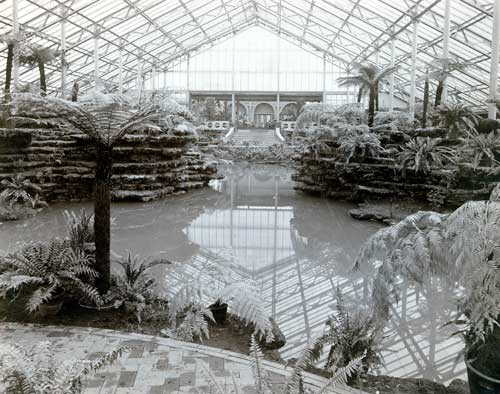
Chicago’s Garfield Park Conservatory, a possible venue for a delegate visit at the 2010 LivCom Finals
Rooted in Innovation
"I have always thought that if the city cannot come to the country, then the country must come to the city."
Jens Jensen, Siftings, 1939
In 1905, newly appointed General Superintendent and Chief Landscape Architect for the West Park System in Chicago had an enormous job ahead. The parks’ infrastructure had seriously deteriorated due to previous mismanagement and corruption. Part of that infrastructure included three dilapidated greenhouses in three separate parks. The new superintendent, Jens Jensen, decided to replace the three houses with a single structure, nearly two acres under glass; the largest public greenhouse in the world. In his vision, this greenhouse, the Garfield Park Conservatory, would not only be the largest, but the first of its kind on other fronts.
Through his years as a park designer, Jensen increasingly embraced the Midwestern landscape. He believed that connecting people with the beauty of nature would both uplift their lives and serve the cause of conservation. His designs became more vernacular, including his new greenhouse. He rejected the exotic styles of contemporary American greenhouses and sought to create a new form that reflected his beloved vistas. Working in collaboration with Prairie School architects Schmidt, Garden and Martin and the New York engineering firm of Hitchings and Company, Jensen designed a simple, strong shape emulating the haystacks of the Midwest. It wasn’t just the building’s structure that was radical.
Prior to Jensen’s design, greenhouses displayed exotic plants in groups of pots or on benches. Jensen, however, revolutionized greenhouse display by creating “landscape under glass.” His vision was a series of rooms filled with plantings that mimicked the type of scenery one would see outdoors. Instead of pots, plants were installed directly into the soil. He built seven rooms or “houses” in all: the Palm, Stove, New Holland, Economic, Conifer, Show, and his centerpiece, the Aquatic House (now the Fern Room). When the Conservatory opened its doors to the public in 1908, not all the rooms were finished. However, visitors were invited into the Show House, which was planted with spring bulbs and Easter lilies. So began the tradition of the Spring Show, which offers winter weary Chicagoans an early glimpse of spring long before the vernal equinox.
A century later, many things about the Garfield Park Conservatory, its neighborhood and its visitors, have changed. The Conservatory is now part of the Chicago Park District. New names of rooms reflect the modifications of plant landscapes within them. In addition to the Palm House and Show House, rooms include: Fern Room, Aroid House, Desert House, Elizabeth Morse Genius Children’s Garden, and Sugar from the Sun. An eighth house, called Horticulture Hall, an entry pavilion, additional production houses, and several outdoor gardens have increased the size and function of the facility. The neighborhood, once a thriving upper and middle class district is now economically distressed and filled with vacant lots. More important than any physical infrastructure changes, though, has been the change in the Conservatory’s audience. Urban dwellers today are increasingly disconnected from the natural world, as technologies provide climate controlled environments, processed foods, and virtual realities. Visitors who once flocked to the glasshouse to see exotic trees and flowers can now turn to the nature channel on television, or, if they have the financial means, can simply hop on a plane and go to the rainforest. So, how does the Garfield Park Conservatory address today’s challenges?
Innovation. Innovation, not as an antonym of history, but as a philosophy growing side by side with it. Yes, the Conservatory continues to grow exotic plants in striking landscapes and the show house still provides three seasonal displays each year. But recently, the Garfield Park Conservatory began to help deepen the relationship between people and plants. The Conservatory continues the legacy of its founder, Jens Jensen, that “the country must come to the city”, by creating an urban oasis with plants inside the glasshouses and outside in gardens. But, how the oasis is created is where the focus on new ways to help people understand why plants are important in their lives. Three recent developments at the conservatory are prime examples of how innovative thinking has advanced the connection between people and plants in our 21st century state of affairs. These new elements, the Elizabeth Morse Genius Children’s Garden, Sugar from the Sun, and the Living Wall, are focused on helping our visitors of all ages enlarge their thinking and feeling about plants.

Elizabeth Morse Children’s Garden
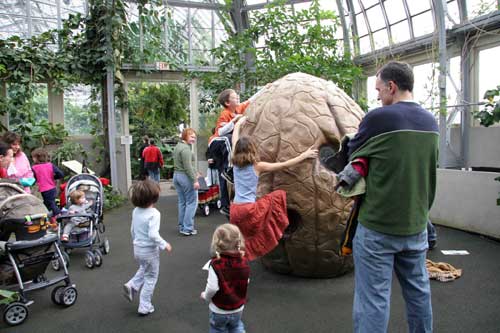
The indoor Children’s Garden was the first of its kind when it opened to the public in 2000. The Plants Alive! exhibit provides children engaging lessons about plants using typical playground activities such as climbing and sliding as well as staffed programming. The room uses play to tell the story about a plant’s life cycle. For instance, birth is represented by a giant seed on which children can climb and peek through portholes to see a plant embryo. In addition to the free play elements, the garden is staffed several days a week by the Garfield Park Conservatory Alliance, the Park District’s partner in education and fundraising at the Conservatory. Activities are hands-on, using a soil table and sensory cart to engage all the sense of the young visitors.
After 10 years of use, the garden is showing some wear and tear. Instead of simply fixing the exhibits, the Alliance is conducting an in-depth study to determine if the garden experiment is actually accomplishing its mission. Once completed, the evaluation will inform the next iteration of design.

Sugar from the Sun
Sugar from the Sun is a new (2008) exhibit and room created in partnership with the Garfield Park Conservatory Alliance. It was funded in part by a $1.7 million National Science Foundation due to its ground-breaking approach to teaching a widely misunderstood concept: photosynthesis. Instead of using scientific language or typical interpretive signage, Sugar from the Sun sparks both emotion and curiosity about how plants grow and why they matter. In fact, the word “photosynthesis” never appears in the exhibit or the supplemental materials. Instead, the living exhibit immerses the visitor in four environments: air, water, sunlight, and sugar. It uses sensory experiences, such as smelling the scent of orchids (air), walking through mist towers (water), and peering up through backlit leaves (sunlight) to show how plants use these elements to produce energy within their leaves. The sugar section surrounds visitors with tangible proof of that energy with fruiting plants, including bananas, papayas, and pineapples. The immersive experience is further highlighted by the unusual non-linear approach of the exhibit. Visitors are free to meander and wander through the room, much as they would do in a natural setting. Because today’s audience is accustomed to a certain level of technological sophistication, the exhibit uses computer technology to move nature recordings along the pathways and lighting that reacts to changing natural light conditions.
Like the Children’s Garden, Sugar from the Sun’s design was informed by state of the art research about scientific learning and the public’s attitudes about plants. Although the garden just opened, we will conduct surveys to assess the effectiveness of the design in improving visitors’ understanding about photosynthesis.
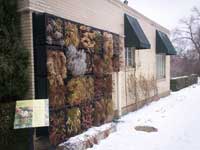
The Living Wall
As climate change becomes an ever increasing challenge for cities, the green architecture movement has been quick to embrace green roofs. However, less attention has been given to green walls. That is unfortunate, as we know that many of the benefits accrued to green roofs also apply to green walls, such as:
- Insulating and shading walls
- Reducing urban heat island effect through the plants’ evapotranspiration
- Trapping dust and particulate in the air
- Taking in carbon dioxide and producing oxygen
- Creating habitat for urban wildlife
- Growing fruits and vegetables
- Increasing green scenery, which in turn, reduces the viewers’ stress levels
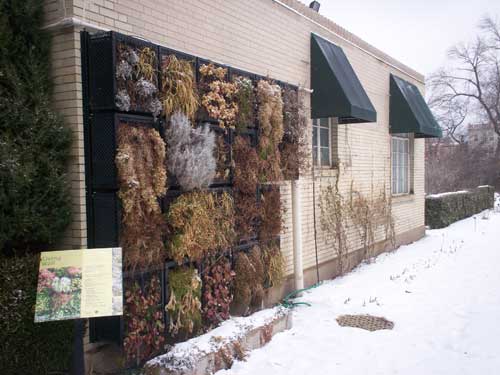
Because Garfield Park Conservatory is a place where visitors seek new plant knowledge, it is a perfect opportunity to demonstrate this technology. In partnership with Tournesol Siteworks, LLC, we installed 11 ft. x 9 ft. living wall on a south-facing outdoor wall in the Conservatory’s Monet Garden. This size was chosen because it is a replicable scale for homeowners. A mix of annuals and perennials were planted to assess the root insulating capacity of the 10-inch deep modules. Adjacent to the living wall modules, vines were planted that will cover the wall. Next to the vine, the wall was left blank. Thermometers installed behind the wall and vines, as well as on the blank wall, will help keep track of wall temperatures.
Like the projects Children’s Garden and Sugar from the Sun, a careful assessment of the successes and failures of the Living Wall will help with the next steps. Because this is the first harsh winter installation for Tournesol, data collected about plant survival will help inform their future design modifications. Informing the public of the process will help visitors understand more about plant development, survival, and the role plants play in their lives.
The Garfield Park Conservatory is a unique institution – it is an historical icon in constant transformation. Its mission has not wavered: to examine, explore, experiment with, and explain our relationship with plants. The ways in which we accomplish that mission have changed. But what hasn’t changed is a tradition of experimentation and a willingness to try new ways to make visitors believe that plants matter. Whether it’s a new approach to children’s engagement with plants or a teaching tool that addresses climate change, the solution is bound to be creative. At Garfield Park Conservatory, the culture of innovation is as rooted in the soil as its 250-year old cycads.
|
|
|
The International Awards for Liveable Communities es
Globe House Crispin Close Reading Berkshire England
RG4 7JS
Tel/Fax : +44 (0)118 946 1680
e mail: info@livcomawards.com |
|